
Story: Natchalee Singsaohae
Along the winding Moei River, where Thailand meets Myanmar, a once tranquil landscape of mountains has been carved open by a massive concrete empire rising like an alien presence under the name “KK Park.”
Though marketed as a new city of opportunity, behind barbed wire fences and the shadows of armed militias lies a far darker reality. This is one of the clearest manifestations of “Dark Zomia”—a borderland where state sovereignty has fractured, giving way to the iron rule of transnational criminal capital that operates beyond the reach of law.
Despite ongoing crackdowns by authorities, a 2025 report by the Australian Strategic Policy Institute (ASPI), Scamland Myanmar, reveals a startling truth. Based on satellite imagery, the compound has expanded at an average rate of 34 rai (≈5.4 hectares) per month since Myanmar’s 2021 military coup. Today, more than 1,300 rai (≈208 hectares) have been transformed into a fully integrated scam-industrial complex.
This is not merely a hidden prison detaining tens of thousands of trafficking victims. It is a self-sustaining technological fortress—resilient, adaptive, and relentless—operating like a creature that never sleeps.
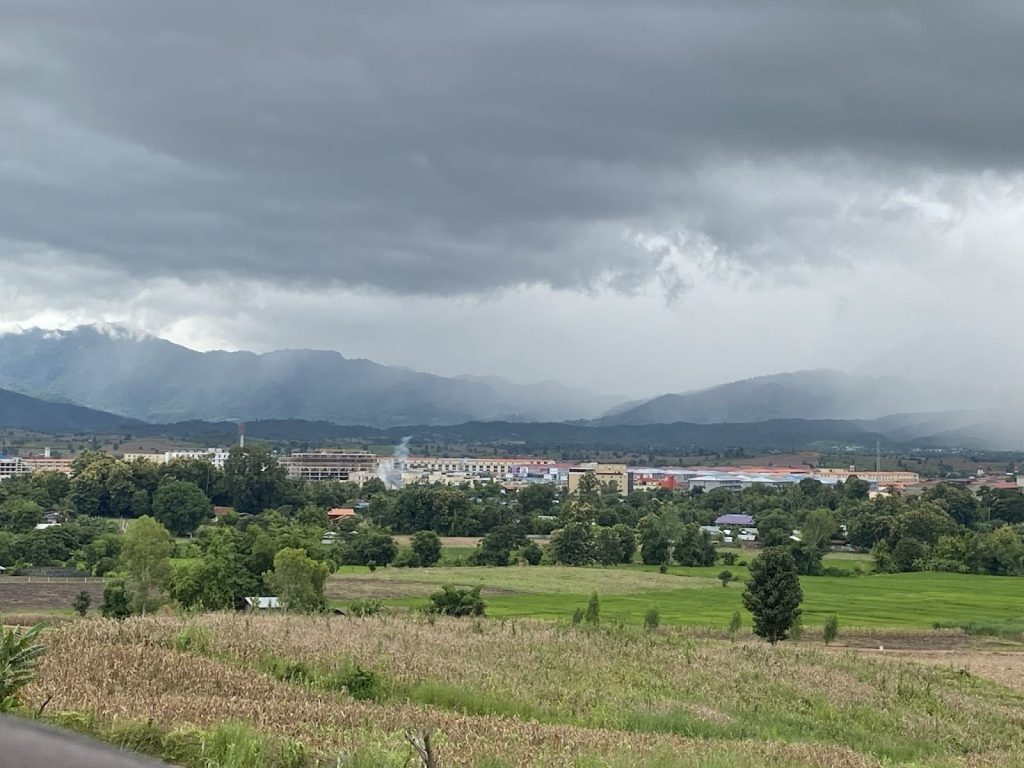
This report peels back the mist of the border to trace the lifelines sustaining this grey empire: from the transformation of armed groups into private security contractors, to the deployment of satellite internet that bypasses state controls, and the extraction of natural resources that leaves scars on local communities. It seeks to expose how this shadow economy grows—by consuming lives, resources, and invisible forms of sovereignty.
The Evolution of Capital: From Thai Casinos to Transnational Mafia
The criminal corridor along the Moei River did not begin with today’s complex call-center scam operations. Its roots lie in the gradual evolution of capital groups that have continuously adapted to global shifts and border politics. As the western frontier changed, a region once marked by protracted armed conflict began to take on a new face. State policy and international politics gradually paved the way for the later rise of grey capital empires. The key phases can be traced as follows:
| Year | Situation / Key Turning Point | Capital and Business Model | Impact on Power and Sovereignty |
| 2012 | A scent of peace. Peace talks began between Karen forces and the Myanmar government, and the atmosphere of conflict started to ease. | The era of Thai capital expansion. Investors moved from Poipet to open on-site casinos and duty-free shops along the Moei River. | A new border economy emerged, still centered on conventional gambling. |
| 2014–2015 | Pressure from the Thai side. Thailand announced the Mae Sot Special Economic Zone (SEZ), but implementation was hindered by legal obstacles and land expropriation disputes. | Thai capital retreated, Chinese capital moved in. Difficult conditions in Thailand led investors to seek direct negotiations with Naypyidaw. | A condition of “leased sovereignty” began to emerge on the Myanmar side, where looser regulations favored grey capital. |
| Oct. 2015 | A major door opened. The Nationwide Ceasefire Agreement (NCA) was signed, and Myanmar opened further to foreign-led development. | Chinese capital infiltrated. Taking advantage of temporary calm, investors began laying infrastructure under the cover of “urban development projects.” | Border areas began to shift from battlefields into large construction sites for transnational capital. |
| 2017–2019 | China cracked down heavily on casinos and mafia networks at home, forcing Chinese capital and criminal groups southward. | The Yatai New City project in Shwe Kokko began. Promoted as a smart city to attract investment, while Chinese capital took over casinos from Thai investors and converted them into full online casino operations. | Long-term 99-year land leases created territories that were increasingly difficult for the state to inspect or regulate. |
| 2020–2022 | The Covid-19 crisis. Border checkpoints closed, gamblers could no longer travel, and the old casino model collapsed. | The era of scammers and trafficking. Grey capital strengthened ties with the Border Guard Force (BGF) and shifted toward online fraud, dependent on communications systems and confined labor. | The area became a full-fledged Dark Zomia, sustained by forced labor and serious human rights abuses. |
| 2023–2024 | Operation 1027 and the BGF transition. Resistance forces briefly seized Myawaddy, while the BGF declared itself independent under the name Karen National Army (KNA). | Construction surged dramatically, with at least 75 buildings detected. A Great Migration of Chinese capital flowed from northern Myanmar to the Moei River, accompanied by the deployment of AI and deepfake technologies in large scam compounds. | A condition of fragmented sovereignty emerged, with territory effectively divided among multiple armed actors and controlled by local militias. |
| 2025–2026 | Election war and airstrikes. The Myanmar military launched heavy bombing campaigns from Dec. 2025 to Jan. 2026 to suppress resistance and showcase anti-scam operations. The use of Starlink was also detected. | Operators adapted by using Starlink satellite internet and laundering money entirely through stablecoins to evade shutdowns from the Thai side. | The condition of a failed state became unmistakable. Criminal enclaves turned into a “global black hole” beyond the effective reach of state law. |
When Farmland Becomes Criminal Deeds
The expansion of this grey kingdom along the Moei River did not begin on empty land. Evidence suggests that it overlaid and displaced border farming communities until they faded from view. What stands today is a new landscape forged by the alliance of capital, armed groups, and infrastructure linked to Thailand.
Reports by Myanmar Now in 2020 and Reuters in 2021 both noted that this strategic stretch of riverbank had long served as an economic lifeline for local communities. It originally lay under the influence of the Democratic Karen Buddhist Army (DKBA) before passing into the hands of the Border Guard Force (BGF) under the shadow of the Myanmar military. That transfer became the starting point for the commodification of farmland.
A 2021 report by the Transnational Institute (TNI) found that these “new city” projects were not built on vacant land, but rather on agricultural land cultivated by local farmers. Many residents said they had been evicted without fair compensation.
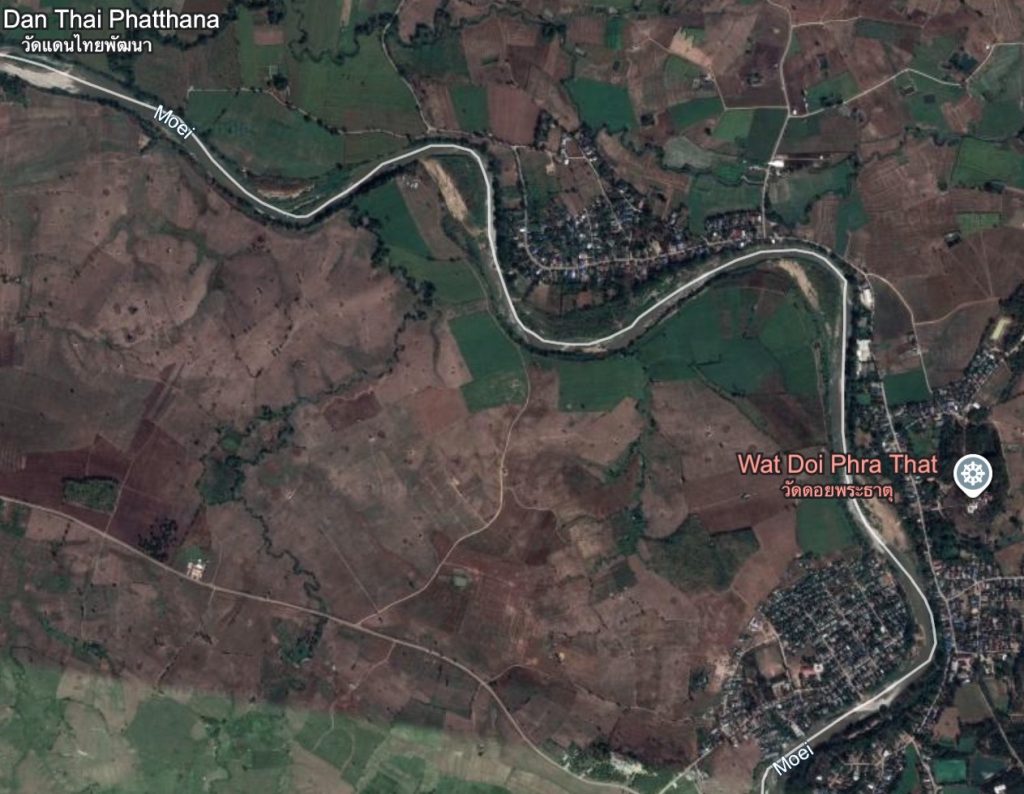
From villages once reliant on nature and cross-border farming, residents of Mae Ku Mai Tha Sung in Mae Sot district, Tak province, now face pollution, gunfire, and bombs following the rise of the scammer empire across the river.
“P’Chomphu” (a pseudonym), a resident of Mae Ku Mai Tha Sung, said the “development” brought by Chinese investors came at the cost of traditional ways of life. She recalled that in the past, the Moei River was abundant with food. Land on the opposite bank, then controlled by Karen groups, served as farmland for Thai villagers, who could rent plots to grow vegetables for just 200 baht per year.
“Back when there was no tap water, we bathed in the Moei, fished in it, washed clothes there. The water was clean, not dirty at all. It was very good. Villagers crossed over to grow corn and peanuts. They grew very well. The rent was just 200 baht per person per year, and you could clear as much land as you wanted.”
The turning point that permanently changed local life came when power over the borderland changed hands. What had once been an area under Karen influence, where Thai villagers could freely cross and rent farmland, was seized by the Myanmar military.
“More than thirty years ago, Myanmar came in and took over. Once it became Myanmar’s land, people stopped going because they were afraid of bombs,” Chomphu recalled.
Land once rich with cornfields and peanut farms became a danger zone, where villagers could lose their lives simply for trying to cross over and gather wild vegetables as they used to. A way of life that had lasted for decades came to an end, marking the beginning of an estrangement between the two sides of the Moei River that still scars local memory today.
In terms of natural resources, the geography of the Moei River is also being transformed by the advance of large-scale construction. Villagers described how sand dredging in the river for use in construction across the border has caused the Thai riverbank to erode and collapse along the river’s bends.
At first, some villagers admitted they had raised their hands in support of the projects at public consultations, hoping they would bring jobs and income. In reality, however, the system turned out to be a closed one, refusing Thai labor and purchasing almost nothing from local communities.
After 2020, the green fields that once defined the landscape were violently transformed. Earth was filled in to drive foundations for high-rise buildings and integrated casinos. By May 2023, at least 75 concrete buildings had emerged across notorious grey zones such as KK Park and Shwe Kokko.
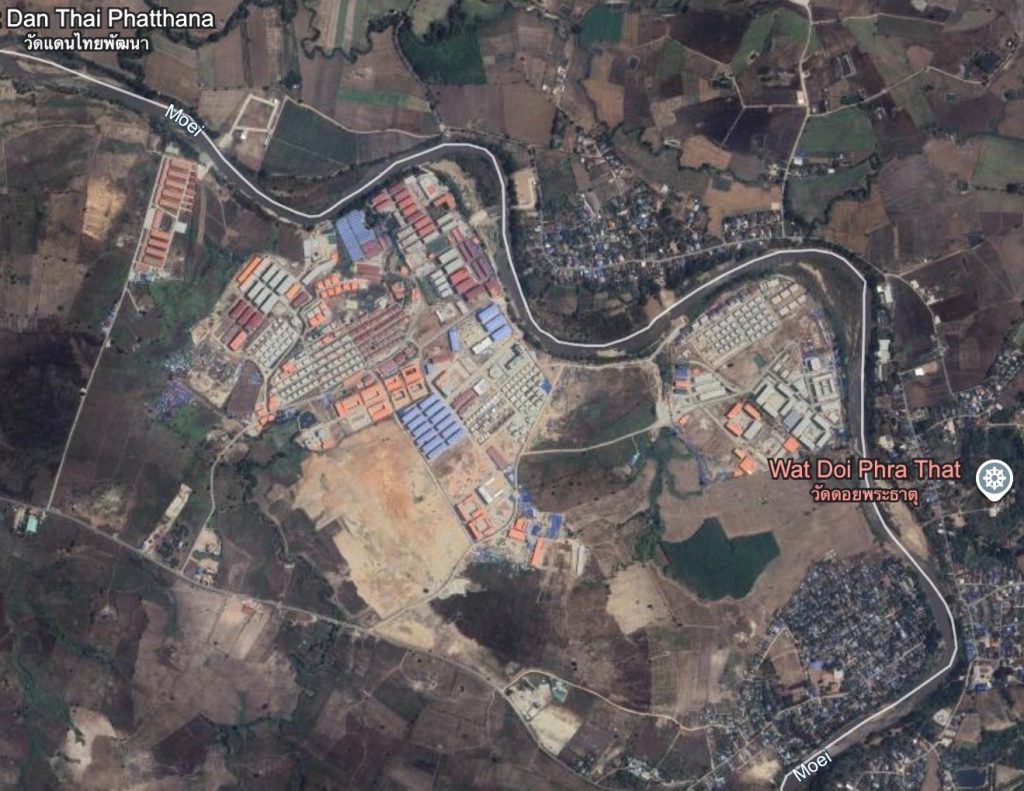
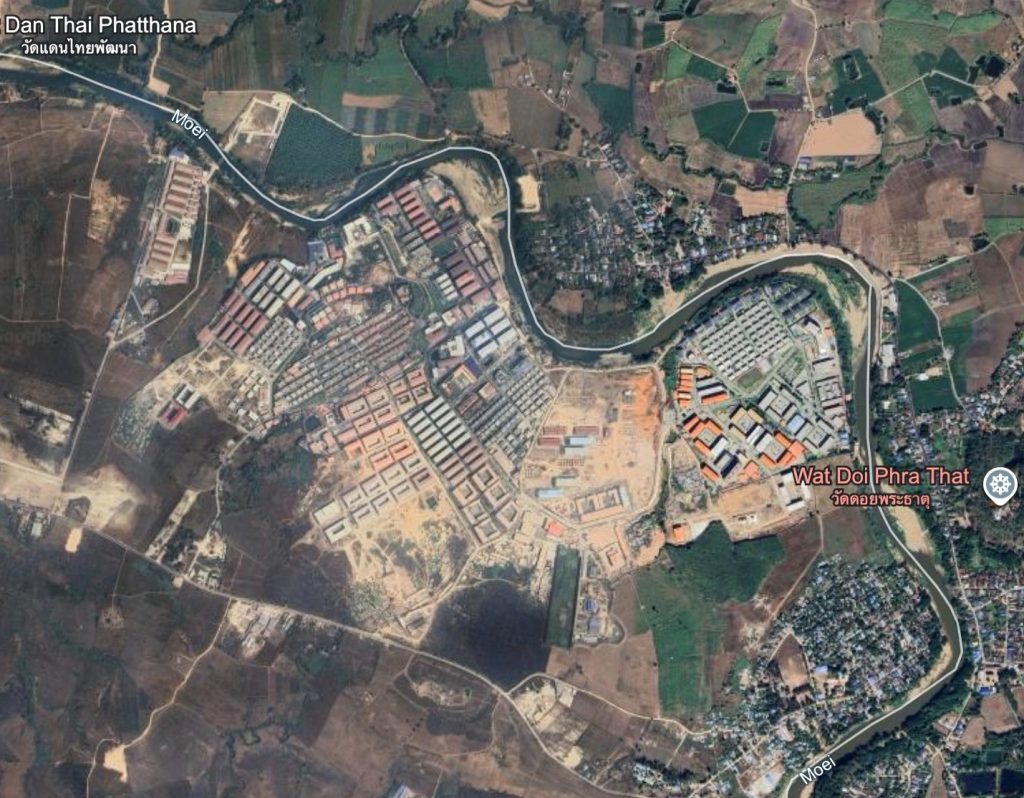
The United States Institute of Peace (USIP) reported in 2020 that the Yatai New City project in Shwe Kokko alone covered 120 square kilometers, or about 75,000 rai. This immense territory was appropriated or seized by the BGF and handed over wholesale to Chinese capital, permanently destroying land rights and riverside community forests.
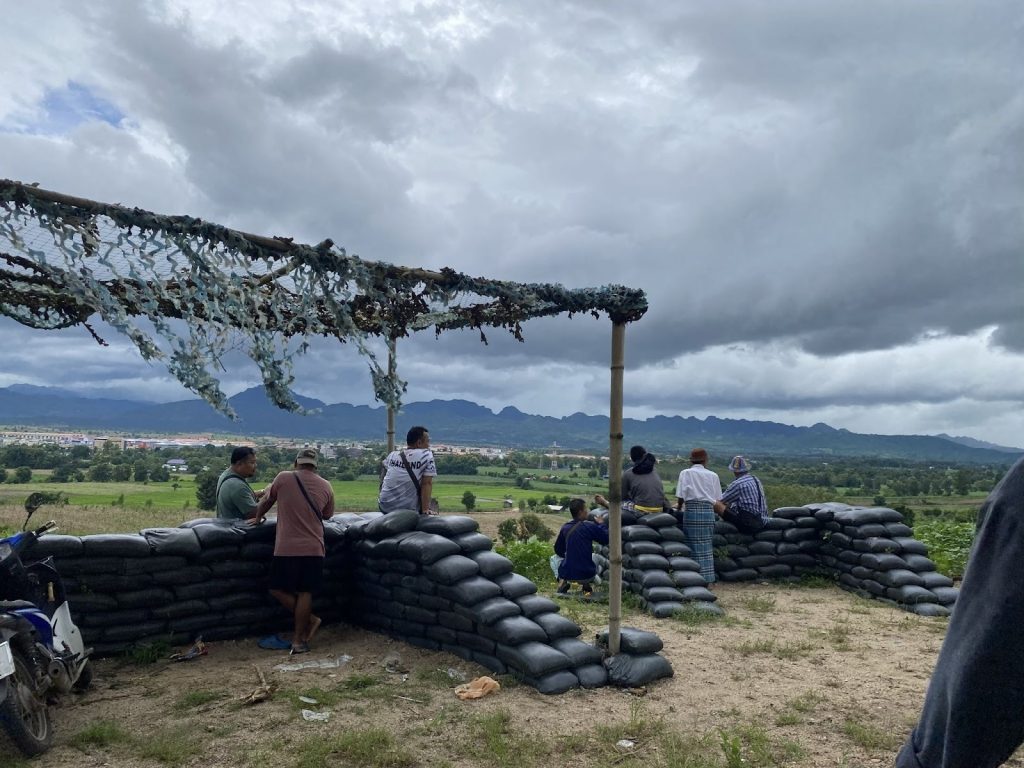
Where paddy fields once stretched across the plain, reinforced bunkers now stand under military operational orders. Two Thai Rangers from the 35th Ranger Regiment, stationed on surveillance duty, said tensions became markedly more intense after the crackdown bombings at KK Park on the Myanmar side. Their mission shifted from conventional soldiers to ranger units required to maintain 24-hour vigilance.
(Interviewed on 20 December 2025)
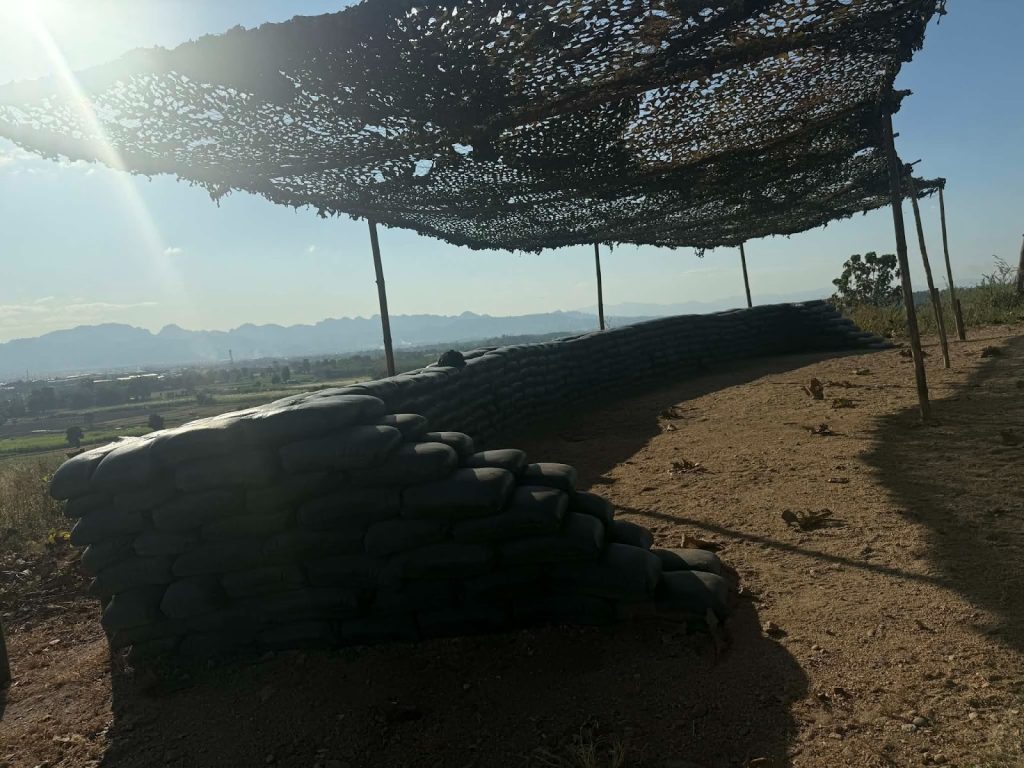
Conflict has become part of daily routine. The sound of Myanmar-language radio messages shouted back and forth, alternating with warning sirens from across the river, no longer startles the soldiers. They know the bombing timetable follows a fixed pattern: typically four times a day, at 10:00 or 11:30, 12:30, 14:30, and 16:30.
More than that, before bombings occur, or when orders come from the Myanmar side announcing imminent strikes like those heard earlier, someone translates the messages into Thai and sends them via Line to soldiers on guard and patrol duty in advance.
Another villager, “Mae Phim” (a pseudonym), said that when the project first began, public consultations painted a hopeful picture of local employment opportunities, which was the main reason many villagers agreed to support it. But when the project went ahead, they found the economy it generated was entirely closed off, with no place for Thai labor and no meaningful local circulation of income. Worse still, it brought environmental problems, including wastewater and noise pollution.
“The electricity drops every day. The tap water is dusty. At night there’s smoke from burning tires and garbage, and the smell is awful… When they bomb, the blast fragments shake the whole house. The walls crack, glass falls out, ceiling panels drop. People’s homes are destroyed.”
Mae Phim also said that the scammer compounds have drawn in people of many nationalities who were lured there for work and later tried to escape across the border in exhausted condition, carrying nothing with them. Their plight reflects the hidden underside of the rapidly expanding concrete empire, rising amid the fragility of the traditional riverbank way of life.
Yet the changes have not stopped at the border. They have spread into Mae Sot itself through a growing atmosphere of fear. A 54-year-old taxi driver who left Bangkok in search of peace said that whenever a passenger pins a destination near the border, anxiety sets in immediately. In the eyes of outsiders, the area has come to be seen as a danger zone.
The harms of the scammer economy do not remain on the Myanmar side; they are also eating into lives in Thailand. Someone close to him lost hundreds of thousands baht in retirement savings. Several of his fellow taxi drivers were similarly deceived through schemes involving “purchased airline tickets,” lured by the promise of a 2,000-baht fee before being tricked into transferring advance ticket payments into wallet accounts, losing an average of 5,000 baht each.
In the past, Mae Sot was crowded with foreigners—Chinese, Indians, and Pakistanis—flowing from the airport to hotels. Taxi drivers were so busy they barely had time to rest, without ever knowing who was the predator and who was the victim in the concrete kingdom across the river. Now tourists are fearful, and taxi drivers have had to become informal situation reporters, reassuring passengers by explaining safe zones and secure routes, simply to keep the tourism sector alive.
Dark Zomia: A Zone of Leased Sovereignty
What has appeared on the Moei Riverbank is not merely modern construction, but the emergence of Dark Zomia: the dark extension of the old frontier refuge from state power, now transformed into a systematic haven for transnational crime through the commodification of sovereignty itself.
Prof. Dr. Pinkaew Laungaramsri, lecturer at the Department of Sociology and Anthropology at the Faculty of Social Sciences, Chiang Mai University, explained that borderlands were once conceptualized through the work of James C. Scott as “Zomia”, a shatter zone where state power was fractured. Historically, such areas brought together those the state labeled criminals: escaped conscripts, smugglers, communists, drug traders, and ethnic armed groups. People in these borderlands used such conditions to evade the state, since central authority could not fully penetrate them. Borderlands thus became havens for illicit activity in every era.

But today, Pinkeaw argues, the landscape along the Moei River has entered a new condition she calls Dark Zomia. It is no longer stateless space. It is a space in which the state has handed sovereignty over to capital, allowing it to serve as an organized base for transnational criminal operations.
She explained that the contemporary scammer industry has transformed this dark borderland in three main ways:
1.The transnational scale of victim-hunting
Traditional crime often targeted specific groups or operated locally. Scammers use technology to prey on victims across the world.
2.A corporate-style organizational structure
These operations function like industrial enterprises, systematically linking investors and mafia networks.
3.The seizure of infrastructure
Roads and internet systems once used by states to control territory have instead been appropriated by criminals as their primary operational tools and as means of concealing their activities.
In the world of transnational crime along the Moei River, what sustains these kingdoms is not merely immense capital. It is as if state power itself has been cut into pieces and sold off. The Myanmar military government and the Border Guard Force have turned frontier land into a commodity through special lease deeds, polished with labels like new city or smart city.
But in reality, this is not an ordinary business lease. It is the sale of legal exemption to Chinese grey capital.
“It’s not just leasing land. It’s handing over sovereignty… to let capital profit at the lowest possible cost, with lease contracts functioning as shields against liability,” she said.
This phenomenon has transformed the borderland into a zone of leased sovereignty, where illegality can become legitimate so long as interests align. The result is not only the loss of geographical territory, but the rise of a criminal autonomous state that siphons resources from Thailand as its lifeline while using gun power from Myanmar as a shield, accumulating wealth atop tears, human rights abuses, and sovereignty sold at auction.
Cross-Border Lifelines: When Thai Infrastructure Becomes the Breath of Dark Zomia
The criminal empire that has expanded so rapidly along the Moei River could not survive sustainably without support from infrastructure and power mechanisms on the Thai side. This condition of support is clearly visible in the transfer of essential resources that enable transnational grey capital to operate. It is a mutually beneficial arrangement for which state authorities can neither deny responsibility nor plausibly claim ignorance.
Pinkeaw noted that fieldwork and interviews with construction suppliers in Mae Sot revealed that almost all materials and equipment used to build these kingdoms were ordered and transported from Thailand.
“Large shipments like these have to pass through official crossings. It is impossible that Thai authorities do not know,” she observed.
Yet more important than concrete itself are the main arteries of energy and digital connectivity. Reports by BBC Thai, Thai PBS, Prachatai, and Tranborder News all confirm that these compounds have depended primarily on electricity and high-speed internet cables running across the border from Thailand. Even after authorities announced cuts to power and signals in areas like Shwe Kokko and KK Park under international pressure, these capital networks proved strikingly adaptable.
Meanwhile, the 2025 ASPI report based on satellite imagery found that scam compounds had installed large numbers of Starlink satellite dishes and large generators, creating technological loopholes beyond the reach of state control. Their fraud operations continued with little interruption.
In this sense, Pinkeaw argues that the activities sustaining scam cities have always unfolded in full view of state authorities. This includes not only construction materials, but also the digital networks that function as their arteries. Most recently, in January 2026, cross-border internet cabling was reportedly discovered in Phop Phra district, raising major questions about the responsibility of both private companies and the state.
“Can the owners of internet companies really not know that the cables are being pulled across the border?” she asked.
It is precisely this deep entanglement within structures of power that Pinkeaw describes as a “scammer state.” By this she means a condition in which criminal capital networks penetrate the Thai state apparatus through patronage, informal payments, and collusion that reach all the way to policy level.
Measures such as cutting power or internet signals are seen as merely addressing symptoms, and only temporarily. So long as these reciprocal relations among power holders are not seriously uprooted, the scammer business, wherever it relocates, remains ready to regenerate and resume operations as soon as interests realign and the lifelines from Thailand resume flowing.
Ultimately, Pinkeaw stressed that this is not an accident, but an indicator of how deeply entrenched these reciprocal benefit networks have become, operating so systematically that they are almost part of the border economy itself. Short-term measures such as cutting electricity, water, or internet are only superficial solutions.
“As long as the reciprocal ties among those in power are not seriously dismantled, scammer businesses, wherever they retreat to, will always be able to come back to life. The heart of the problem is not the buildings or the cables, but the patronage system and dark relationships linking transnational grey capital to Thai power holders, who are always ready to reconnect the lifelines and help these businesses breathe again as long as the benefits still align.”
Whitewashing Crime Beneath the Fog of the ‘Smart City’
Behind the large-scale construction projects lies a struggle over narrative and information management aimed at generating international legitimacy. Transnational capital is not investing only in buildings. It is also investing in the image of development, seeking to present these projects as legitimate new economic zones through labels such as New City and Smart City.
This strategy is clear in projects such as Shwe Kokko, marketed under the name Yatai New City, where promotional materials emphasize modern technology and economic opportunity for local communities. These narratives function as the first line of reassurance for investors and as policy shields. Yet they often sharply contradict the realities experienced by villagers on the ground.
The impact on traditional ways of life in riverside communities has become a central concern alongside the growth of these new cities. Where villagers once relied on the Moei River for daily use and consumption, local accounts now say the water quality has changed. Strange odors and oily residue are believed to be discharged from the industrial compounds, making aquatic life unusable in ways it once was not.
At the same time, the rapid construction of vast concrete buildings is altering the river’s physical structure. Construction requires large quantities of sand and stone. Although there is still no official evidence from state agencies confirming whether sand extraction permits were granted for these projects, the collapse and slippage of the Thai riverbank and the unusually low water levels in recent years have led local people to suspect a connection to the ongoing dredging and heavy machinery operating in the river.
While projects such as KK Park and Shwe Kokko continue expanding under strict security systems, villagers’ hardships also include threats to daily safety from armed conflict along the border and restricted access to former forest areas now believed to contain explosive hazards. Some residents admitted that their hopes for local jobs have collapsed. Promises of local employment discussed at the project’s outset turned into a closed economic system that leaves local communities with almost no role at all.
The fog of the phrase smart city has therefore become a key strategy by which capital seeks to reshape perceptions of these riverside kingdoms into images of modern economic development, relegating environmental damage, land rights, and the voices of small people in the area to secondary concerns beneath construction projects worth tens of billions of baht that are permanently transforming the Thai-Myanmar border.
Uprooting the ‘Scammer State’: A Test of Sovereignty Under the Shadow of the Moei
The Dark Zomia crisis along the Moei River today is not merely a border crime problem confined to the Myanmar side. It is a crucial test of sovereignty, ethics, and the sincerity of the Thai state in confronting transnational crime. Conventional responses focused on symbolic crackdowns, or on acting merely as spectators, are no longer enough. This vicious cycle will end only through serious reform aimed at uprooting the dark industry altogether.
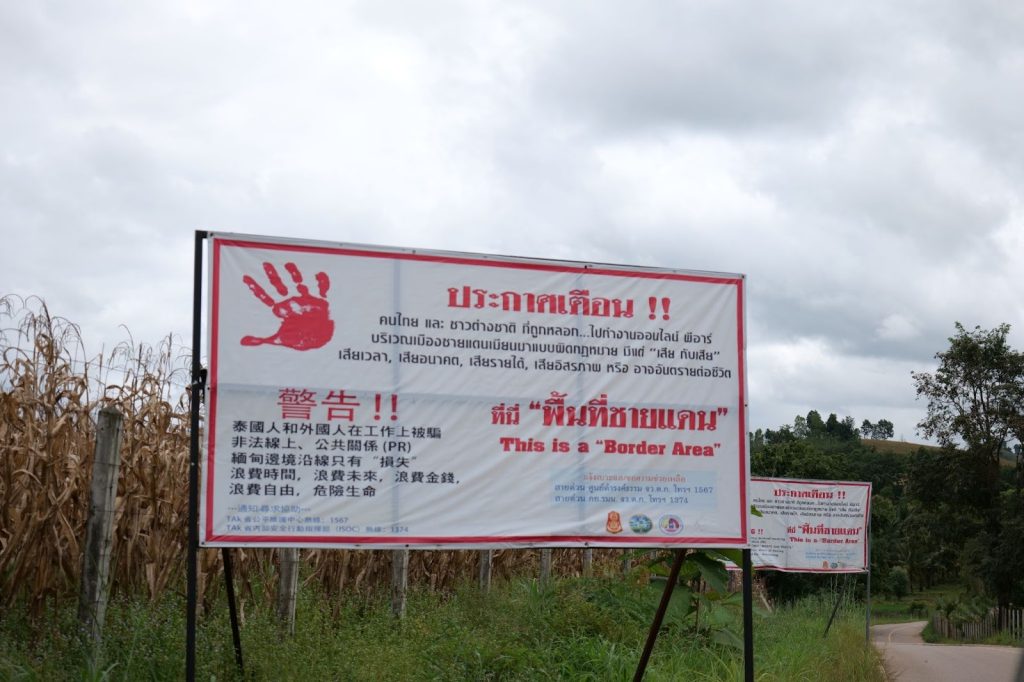
The most important recommendation from Pinkeaw’s analysis is the dismantling of the patronage networks embedded within state agencies and local power structures. Thailand must cut out the roots of grey capital that have wormed their way into the bureaucracy by establishing an independent investigative body with full authority to act against officials implicated in patronage payments and cross-border infrastructure support. This should be paired with the formal blacklisting of transnational criminal groups to prevent dark capital from using Thailand as a laundering base or as a safe haven through Thai capital markets and real estate.
Administratively, Thailand must end the fragmented mode of governance that creates openings for criminal infiltration. It needs a clear lead agency, transparent and explicitly mandated to suppress scammer operations in an integrated manner, working in coordination with international organizations to bring these twilight zones back under the oversight of international law.
Because if the Thai state continues to look away and remains the lifeline of this dark empire, whether through electricity, internet connectivity, or collusion at policy level, the consequences will not stop at Myawaddy. The pollution of crime will flow back into Thai society permanently, as villagers and wage earners in Mae Sot are already beginning to experience firsthand life savings lost to fraud and a distorted border economy.
Pinkeaw concluded with a warning: if we continue allowing the politics of collusion to operate unchecked, the Thai state itself may not escape becoming a scammer state in full. The time has come for Thailand to decide what it wants to be: a strong wall protecting its people, or a bridge that allows grey capital to cross in and gnaw away at the foundations of the nation beyond repair.
Because without reform at the roots today, Dark Zomia will not remain merely an extraterritorial zone. It will become a shadow cast across the future of Thai society for a very long time

