
Story: Kullathida krajangkul
During late December 2025 to early January 2026, the State Administration Council (SAC) held the Myanmar general election amidst the ongoing civil war. This election was criticized as not free and fair, as many areas could not hold elections, opposition parties were abolished, and many politicians were detained. However, for the military junta, the elections serve as “minimum legitimacy” to claim state continuation and maintain their tenuous status as a “negotiation partner” on the international economic stage, especially regarding the supply chain of strategic resources such as rare earth elements and critical minerals, which are a fulcrum in the geopolitical competition between China and the United States of America.
The official election results show that the Union Solidarity and Development Party (USDP), a party with close ties to the junta, won 231 seats in the National Assembly and 108 seats in the Ethnic Council after the National League for Democracy and over 40 other parties were abolished. Even before the ballot date, this election was widely seen as a way for the military to maintain control of Myanmar. The electoral system chosen was proportional representation, a system favorable to the military. The Kachin and Shan state, an important economic hub for rare earth minerals and inter-border trade, could not hold election. Hema, an independent Myanmar environmental researcher, reported that the military junta was only able to hold elections in about one-fifth of the country. As a result, the elections function more as a legitimizing legal ritual than as a genuine representation of the people’s voices from the conflict zones.
The resulting reaction from the international community reflects the tension between geopolitics and resource access. While Beijing supports the election to strengthen border security and secure the supply chain of REEs, the United States and its allies deny the election results and have introduced a boycott of Myanmar. On the regional scale, ASEAN has not reached a consensus on its stance, as it must maintain a delicate balance between international pressure and regional political constraints. At the same time, the military junta is facing severe economic pressure. Foreign direct investment has decreased by 74% since the coup; consequently, rare earth minerals have become a main source of income and a bargaining chip for the military government.
However, efforts to centralize resource management have clashed with realities on the ground, as many mines are under the control of the Kachin Independence Army (KIA) and the United Wa State Army. These ethnic armed organizations (EAOs) have deemed the general election void and have used these resources to support their power base.
“After the election, management of rare earth mining will be increasingly dispersed, not only due to the fragmentation caused by the war but also because resources have become a bargaining tool for each EAO,” said Hema. She also mentioned that the central government is no longer regulating rare earth minerals. These resources have become the center of an “economy of conflict,” where control over strategic resources leads to bargaining power in politics, economics, and claims to self-determination in conflict areas.
Money from Green Arteries Fuels Battlefields as Clean Energy in Grey Supply Chains Decimate Myanmar’s Forests
Diving deep into the forests of Kachin and Shan States, dark green trails appear in satellite imagery. These are not only scars on the landscape but also the “arteries” of the rare earth industry, nurturing both the civil war and the global green economy.
In the past decade, Myanmar has become a major producer of Heavy Rare Earth Elements (HREE), with around a 16% share of the global market. The report Conflict Economy – Five Key Insights into Myanmar’s Rare Earth notes that since China tightened its environmental policies in 2017, Myanmar has become a major source of HREE mining. Myanmar is estimated to supply around two-thirds of the HREE used in industries such as electric vehicles, wind turbines, and modern military equipment.
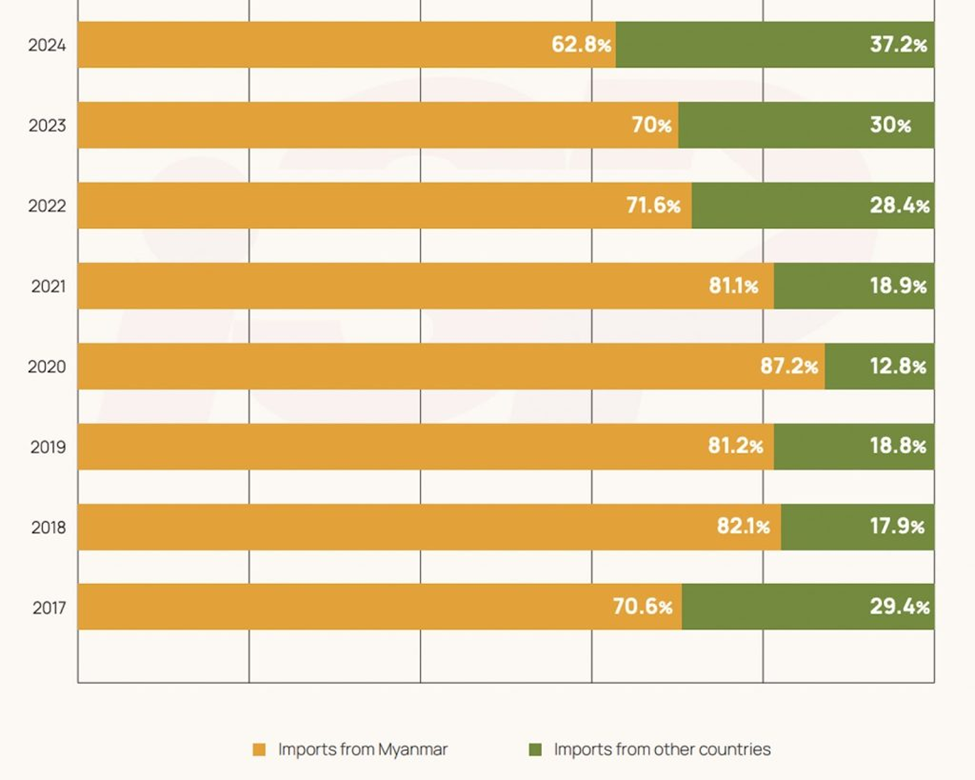
Between 2017 and 2024, Myanmar exported over $4.2 billion worth of rare earth minerals to China. About 85% of this value occurred after the coup. The 170,000 tonnes of HREEs exported are equivalent to the weight of about 23 Eiffel Towers and constitute an almost fivefold increase compared to pre-coup exports.
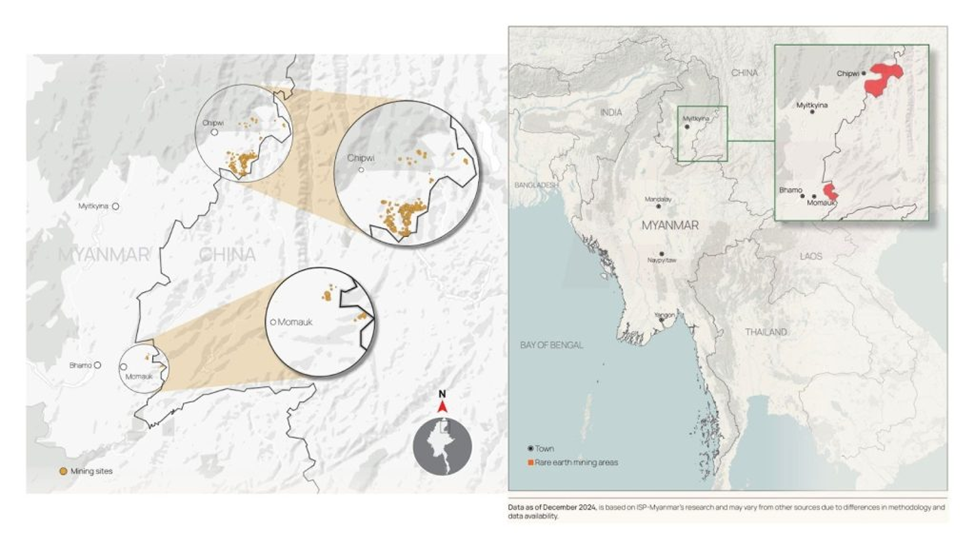
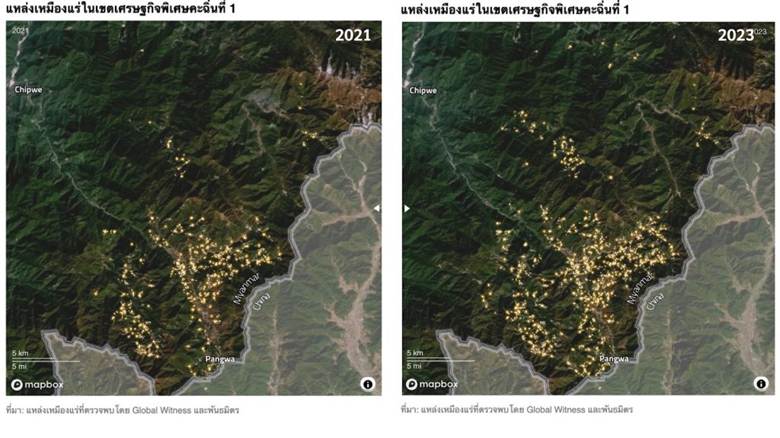
The lack of transparency has created a loophole for foreign companies to continue operating despite the boycott, including investors from Australia. This is particularly evident in Kachin Special Zone 1, an important mining area. In Chipwi and Momauk, mining activities have grown by 194%. In Chipwi alone, the number of mines has increased from 100 to 357, and more than 2,500 new in-situ leaching wells have been documented, showing a 150% increase. These new mines and in-situ wells are located across 13 sub-districts and affect more than 36 villages.
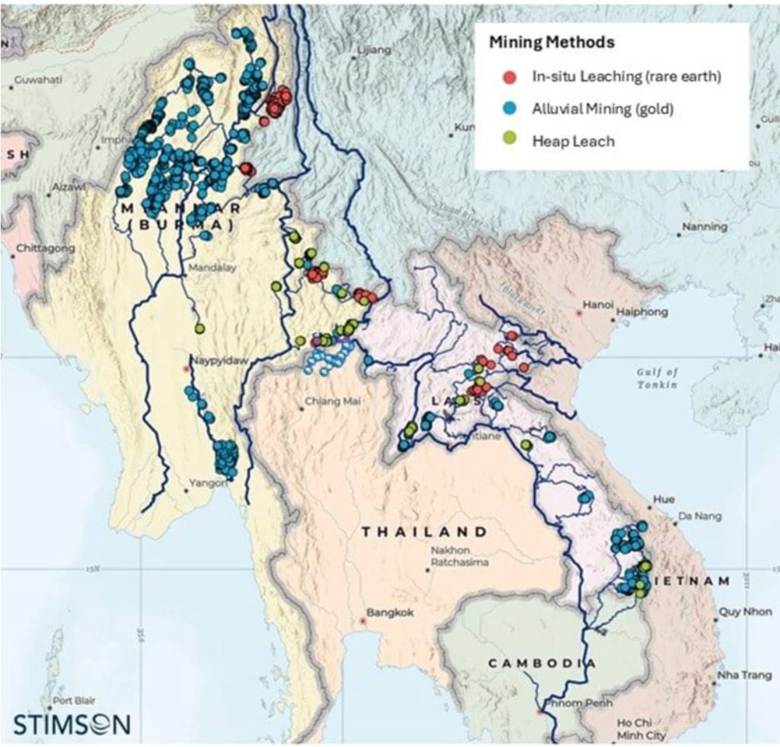
The Stimson Center reported that there are at least 57 rare earth mines in the Nam Lwe River basin in Wa State. The majority of these mines are situated deep within watershed forest areas. The data aligns with the Shan Human Rights Foundation’s documentation, which identifies at least 19 newly built mines in areas of eastern Shan State controlled by the National Democratic Alliance Army (NDAA). Most of these mines are already fully operational.
The exponential expansion of the mining industry in Myanmar is not a mere coincidence, but a direct consequence of the worsening civil war. A report from The New York Times stated that the prolonged conflict following the junta’s repression has pushed EAOs and pro-democratic resistance groups to take up arms. This escalation requires the massive mobilization of resources, leading many groups to turn toward the “informal economy” to fund their military activities and power base.
Informal activities spreading in mining areas involve not only resource extraction but are also connected to various illegal businesses, including narcotics production, opium cultivation, wildlife trafficking, and international scam operations. These activities are deeply linked to Chinese organized crime syndicates that have moved their base of operations to the Myanmar borderlands.
“Everyone needs money, everyone needs arms, and these minerals are cash dug from the ground. It is similar to other types of war—not the sound of guns, but the sound of the land being eaten away,” said Hema. She stated that rare earth minerals have become a main source of income for both the military junta and many EAOs to procure weapons and sustain their authority.
A report from the United Nations Office on Drugs and Crime (UNODC) stated that, after a domestic crackdown in China, networks of Chinese organized crime played a significant role in the expansion of illegal activities in Southeast Asia. A report from the United Nations Interregional Crime and Justice Research Institute (UNICRI) also noted that Chinese companies are the main buyers of rare earth minerals in the area. Despite Myanmar’s laws prohibiting foreigners from owning mining businesses in the country, Chinese companies remain key players on the ground and major operators within the supply chain, especially in contested areas.
This contradiction is clearly reflected in the trading data. While rare earth mineral export data are not presented in official Myanmar bureaucracy, Chinese customs documents clearly indicate that rare earth minerals originate from Myanmar. This information aligns with the accumulated trade discrepancy value of more than $63 billion, with around $45 billion occurring after the 2021 coup. This enormous gap suggests that massive amounts of resources are flowing through informal networks amid the struggles between EAOs, the Border Guard Forces, and other armed groups. ISP analysts stated that Chinese beneficiary networks are a key factor in this equation.
Hence, the fast-growing informal economy in Myanmar is eroding the domestic economic structure. Income from these resources is diverted away from the tax system, while the population faces higher prices for consumer goods, inflation, and economic uncertainty. In this context, rare earth minerals are not only an economic resource but also fuel that sustains the conflict economy and power structures amid the ongoing war.
Health Crises, Lost Livelihoods, and Collapsing Ecosystems: The Human Costs of Pollution from the Rare Earth Supply Chain.
“It’s strange that their world becomes cleaner while ours is dying. When I look at the river in my hometown, I want to ask: what about our environment? Aren’t we living on the same planet?”
Hema recounts that after the expansion of mines in 2021, her village transformed rapidly. The lush mountains became riddled with countless holes from the in-situ leaching process. This process involves injecting concentrated chemicals, such as ammonium sulphate and oxalic acid, into the soil to dissolve minerals.
Although this process does not require the removal of topsoil, toxic chemicals are leaked into underground water sources. These pollution residues have contaminated the community’s limited natural water supplies. The stream that once served as a source of drinking water became thick and hazy, with an acidic odor and chemical bubbles. Aquatic plants and fish have disappeared.
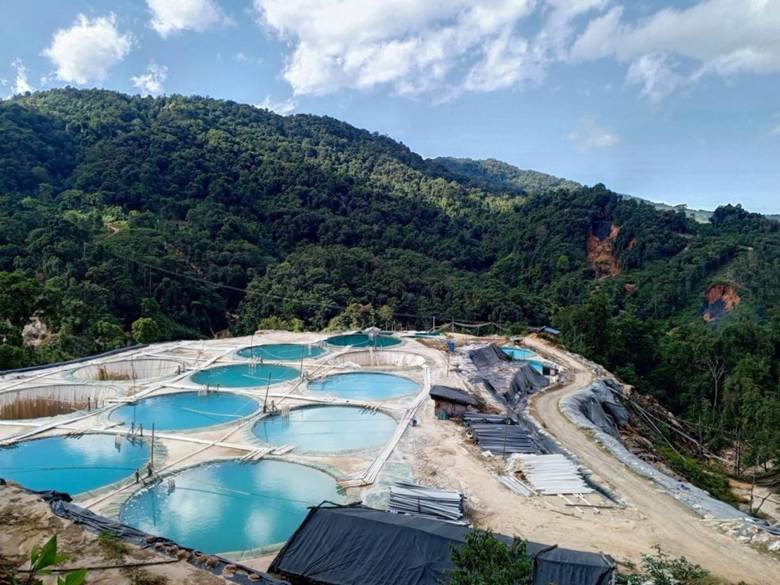
This pollution has eroded the local economy to its core. Crops have become contaminated and can no longer be exported to China, while livestock have been decimated by lead and heavy metal contamination in the water.
“Outsiders talk about minerals valued in the billions of dollars, but for us the cost is seen in our bodies. Many laborers inject chemicals into the soil without protection—some only wear cloth masks, and some wear nothing at all. They only know they will get paid for a day’s work, but no one tells them about the consequences.”
While the world focuses on the value of these minerals, the majority of mine laborers are internally displaced people (IDPs) who are forced to work amid radioactive dust and highly concentrated acids without any personal protective equipment (PPE). Many suffer from chronic coughs, dyspnea, and severe skin rashes resembling burn injuries.
One of the most distressing cases involved a woman laborer in the village who suffered a miscarriage. Although a doctor suspected that chemical exposure may have caused it, no investigation was conducted. These mines operate in a legal vacuum under the influence of international criminal networks and capital. The laborers are trapped in conditions resembling “modern slavery,” where they face extortion and exploitation.
“The mines do not only extract minerals; they also drain the security of our community. Many young men have started using yaba, an amphetamine, and many have fallen into debt. Some have been trafficked and disappeared. Gender-based violence is also rising, and it’s becoming riskier to be a women in the mining zones.”
This crisis goes beyond health impacts; it has transformed the entire way of life. When cash and foreign workers flow into the area without proper management, drugs and human trafficking become widespread. Women also face sexual harassment and domestic violence, but few dare to speak out against the capital groups controlling the area.
She insisted that the impact of the mines does not stop at the in-situ leaching wells. It spreads through people’s lungs, into the womb, and into familial relationships.
“The main question is not who control the mines, but who holds responsibility.”
Hema explained that as long as the war continues and the energy transition lacks transparency, the rare earth “arteries” will continue to circulate—sustaining both the future of a green world and the darkness in conflict-affected areas.
“War does not exist only the territorial conflicts and occupation. It lives in the rivers, in the soil, and in our bodies—and it may even exist in the magnets on the other side of the world.”
River Basins, Another “Victim” of Cross-border Pollution
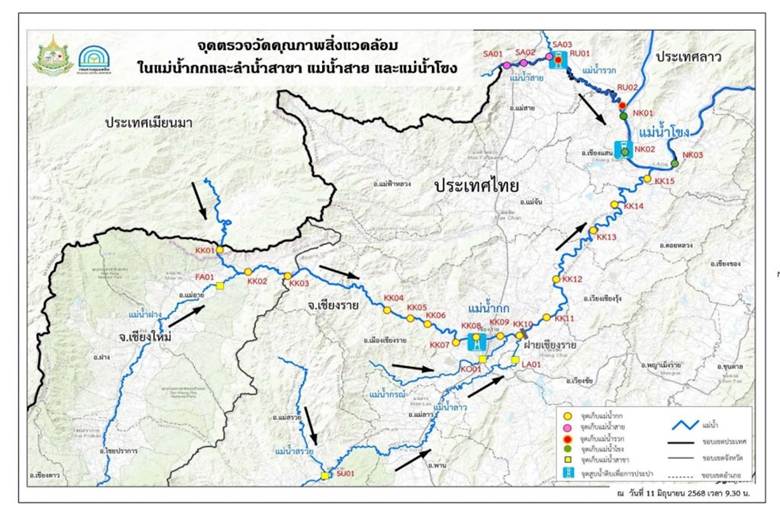
The impacts of rare earth mining do not stop at Myanmar’s borders. Chemical pollution from headwater areas gradually flows through streams before joining major rivers in the region, including the Kok, Sai, Mekong, and Salween. This pollution reaches Thailand in the form of toxic residues in sediments, water sources, and the food chains of downstream communities.
The Kok River originates in Shan State and flows through Thailand via Mae Ai District in Chiang Mai Province. The Kok River meets the Mekong River in Chiang Rai. This river is an artery supporting more than 12 ethnic groups and millions of people. Currently, it is susceptible to water contamination from arsenic, cadmium, manganese, and lead. These contaminants are the result of rare earth mineral mining, which can produce 2,000 tonnes of toxic waste for every 1 tonne of rare earth minerals extracted. These toxins do not suddenly appear but travel downstream with sediments. An academic from Chiang Mai University warned that these sediments become “heavy metal storage,” which can destroy the long-term food security of local communities.
A Lanner evaluation mentioned that if the Kok River cannot be utilized for even one year, it would cause economic damage of more than 1.3 billion baht. The tourism sector would be impacted the most, followed by the agricultural and fishery sectors. This circumstance demonstrates that pollution not only destroys ecosystems but also corrodes the economic base of border communities.
In the Mae Sai–Tachilek area, the turbidity of the Sai River and Ruak River has exceeded standard levels due to suspended sediments from gold and rare earth mineral mining in eastern Shan State. Meanwhile, mines on the ridges of Kachin and upper Shan State release chemicals from in-situ leaching that seep through underground water into the Salween River, affecting communities on both sides of the border that rely on agriculture and fisheries.
“It is about the needs of people around the world. Buyers want to buy, so procurers continue to procure. We are just a small voice on the banks of the Salween.”
The village headman of Tha Ta Fang community in Mae Sariang District, Mae Hong Son Province, reflected that the pollution is not caused just by local destructive activities, but it’s a burden put upon the downsteam community by the global supply chain’s demand.
In response to the pollution crisis, the Thai government has assigned the Pollution Control Department to lead the monitoring effots, and formed a national subcommittee to closely track the situation. Between March and September 2025, the Pollution Control Department carried out regular water assessments in the Kok River and its tributaries. The department collected water samples twice a month and sediment samples once a month in order to examine contaminants according to environmental standards.
At the policy level, the prime minister (at that time) ordered relevant departments—including environmental, public health, and administrative agencies—to cooperate on health monitoring and water quality management in affected communities. At the diplomatic level, the deputy prime minister discussed the issue with the Myanmar government to inquire about mines in Shan State. The Myanmar counterpart admitted that some mines in the area are illegal and that governmental control is limited, emphasizing the importance of international cooperation for inspection.
However, the government’s actions through monitoring and diplomatic mechanisms have been questioned by civil society and academia. There is still no clear policy to control mineral imports or trace the origin of materials from Myanmar that may be a direct source of the pollution. Many critics also argue that the government’s approach is treating the symptoms rather than the root cause. Another important question is how effective the Thai government’s diplomatic and economic policies will be in protecting the river and the people along the Kok River in the long term.
Green Colonialism: Green Transition’s Toxic Trail
Amid global efforts to tackle the climate crisis, green colonialism reveals the darker side of the energy transition. While major powers rush to secure rare earth minerals to produce EVs, wind turbines, and other clean energy technologies, the environmental and social impacts are borne by the countries where these resources originate.
The International Energy Agency report stated that the rare earth minerals demand might increased 7 folds in 2040. However, the more rare earth minerals necessity increased the hugh amount chemical, energy and water is needed. As the high quality mines are depleting, the urgency to “save the world” comes with ignored human rights cost and makes damage to communities to “acceptable costs”
In this context, the rare earth MOU between Thailand and the United States, signed under strategic security considerations, positions Thailand as an important part of the rare earth supply chain linked to conflict-affected areas in Myanmar. This circumstance reflects what some academics describe as “green extraction,” the extraction of resources for the global green energy transition. This dynamic resembles a new form of colonialism, where the benefits of clean energy accumulate in industrialized countries while the ecological and social costs are borne by marginalized regions.
“Every time security and peace are mentioned, the question is: whose security? The security of local people, or the security of mineral exports.”
Hema pointed out that diplomatic pressure often increases when the mineral supply chain is disrupted, rather than out of concern for the safety of people living in the area.
For communities near the sources, these natural resources do not bring economic opportunity, only risk: the loss of land, contaminated water, and violence from armed groups controlling mining areas. “If peace means allowing the mines to keep operating, then that is not our peace. It is simply business risk management.”
This contradiction is the crux of climate colonialism, in which developed countries reduce carbon emissions by relying on resource extraction in more vulnerable countries without bearing the environmental and social costs. The pollution flowing through the Kok, Sai, Ruak, Mekong, and Salween rivers does not just affect the riverine communities but also can be seen as the result of a ‘green’ supply chain that ties city-dwelling consumers to the downstream communities’ losses.
For Thailand, the concern should not only be whether to participate in or avoid competition over resources among superpowers, but also to explore the possibility of leveraging its position to establish an investigative mechanism for supply chains and push for a just transition. This would help ensure that solving the climate crisis does not simply transfer catastrophe from one place to another in the name of saving our planet.

